Posts

Showing posts with the label science-fiction

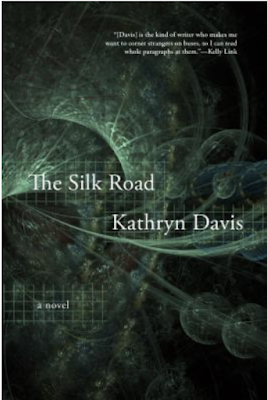
"The Silk Road" by Kathryn Davis (published 2019)
Image
The Silk Road  is set within an interstitial place, somewhere between dream and reality, between the conscious and unconscious, in between anything that allows for something to fit within it. Reading Kathryn Davis' writing in this novel is like falling asleep to music or the sound of conversation; as the mind drifts into deep sleep, the real auditory sounds produce images in the mind - dreams - and the words or music one hears begins to blur within the subconscious of the sleeping mind. As you might be able to guess from what I've written so far, you might be able to tell that the narrative and plot of The Silk Road is not formal, and neither are any other parts of the story, save maybe the characters. "When you arrive at the edge of the world you stop remembering things like how you got there. Your attention keeps pouring over the edge, out and away from the footprints left behind you in the snow, unable to focus on anything except the cove of sparkling light there a...

"The Time Machine" by H.G. Wells (published 1895)

Image
The first line in the Epilogue of H.G. Wells' The Time Machine (1895) is as follows: "One cannot choose, but wonder." Other than how apt a reflection of the Time Traveller's story as well as the main narrator's and how humble an acceptance, how gracious a plea this is, it is also a main marker of the kind of science fiction I enjoy: whether or not one is presented with proven fact is not the issue. The issue is rather thinking and moreover, wondering what's become and what is to become of the story itself. This particular classic novella of science fiction begins with a request: that the Time Traveller's companions; the Medical Man, the Editor, the Psychologist, the Very Young Man, the Journalist, the Silent Man, and our narrator listen to the Time Traveller's story - with no interruptions - hear him out as if he were a professional storyteller indeed. The Time Traveller cares not whether they believe him but it is clear that he wants to tell it....

"Perdido Street Station" by China Mieville (published 2000)

Image
Oh Gods, jabber, Devil's Tail, damn. This book is the best I've read this year. Though -  I'd recommend "Perdido Street Station" to those who are already partial to fantasy, fairy-tales, and science fiction, because the entire novel is heavily steeped in those genre elements and it's an extremely strong brew; a thick and boasty blend, yet a sweet and tart mix of character-driven action, fast-paced at over seven-hundred pages that pulsate with anthropomorphic creatures, evil monsters, a brilliant and non-conforming scientist, beautifully winged-bug maidens, a seedy underworld, a corrupt bureaucracy, sentient A.I. robotrons, pretentious art-world snobs, a hellish brothel of indescribable, sinful creatures and so. much. more.  I'll begin with Isaac, the main character, our passionate scientist unaccepted by his fellows because, well, he's a bit *avant-garde* for his discipline. His thing: Crisis Theory. He's been working on it for some time, but ...

"The Unlimited Dream Company" by J.G. Ballard (published 1979)

Image
In terms of an outright, obvious religious unveiling, "The Unlimited Dream Company" (1979) reminds me of a project similar to Darren Aronofsky's film "Mother!" (2017). However, they cannot be any more different.  "The Unlimited Dream Company" tells a perplexing story about a man named Blake, a man who has grandiose ideas about himself that are fantasical and insane, and definitely what psychologists might note as an "inflated ego". Blake knows this and he can't do anything about it. One day he decides to steal an aircraft and pilot it. He does. He crashes. He finds himself in this mysterious yet wonderful suburb of London, right along the River Thames, called Shepperton. There he falls in love with everyone and everything, in a weird sexual and/or platonic way, wanting to infuse with the entire place a newfound magic he acquired from the crash: a power and magic that allows him to create beautiful dreamscapes of anthropomorphism and ...

"Embassytown" by China Mieville (published 2011)

Image
Because of the ingenuity behind China Mieville's "Embassytown" (2011), the book is enormously fun to read. Like many science fiction books I've picked up before, there was a point when I was aware that I was not comprehending all of what I was "reading", but continued happily on anyway, willing to do the work, understanding what I could, while letting the story flow page by page freely. Usually the ability for the reader to do that with a complex story structure and highly intellectual content is a sign of great style. And that - amazing literary style - is something Mieville certainly does have. This is the first Mieville book I've picked up and I was absolutely mind-blown by its concept. With language as the main thematic element, I emerged myself in the wonderful linguistic games, using my own sparse knowledge of Saussurian semiotics to back-up what I thought I was "getting". Beyond that, I loved the symbolism of the book, which Mieville...

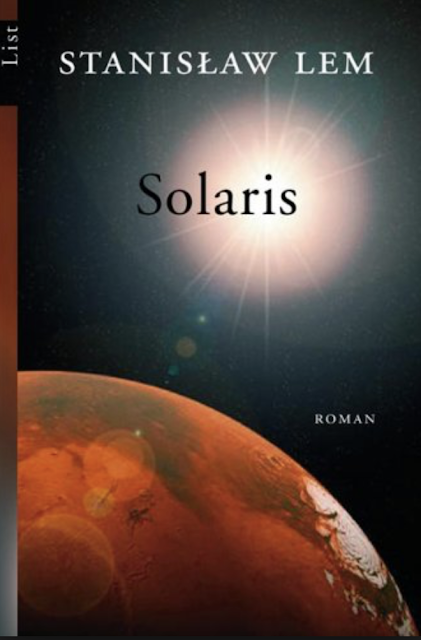
"Solaris" by Stanislaw Lem (published 1961)

Image
For words, we have extensive etymologies, for literature we have comprehensive exegeses, for life we have philosophy, for history we have critical theories, for art we have historical analyses, and the same goes for science. The whole of Stanislaw Lem's  Solaris  (from French and published in 1961) is a beautiful study in  bodies of work such as those, and how, as time passes and consciousness changes, all these criticisms, theories, and conclusions merge and die, sometimes becoming irrelevant or outright wrong, or else become case studies in hysteria or some other psychological manifestation, all the while developing a chronological set of *facts*. The subject in Lem's elegantly written novel is the planet Solaris, a planet that has been under the observation and scrutiny of scientists for thousands of years. The protagonist of this story is Kris Kelvin, a psychiatrist who became fascinated with the planet as a child and consequently dedicated his entire life to it,...

"Do Androids Dream Of Electric Sheep?" by Philip K. Dick (published 1968)

Image
Review edited and updated from yesterday, 12/04/18, today: 12/05/18 "Everything is true,' he said. 'Everything anybody has ever thought." - Do Androids Dream Of Electric Sheep? Ridley Scott's Blade Runner (1982) as well as Denis Villeneuve's Blade Runner 2049 (2017) both prove to be excellent films to be watched in conjunction with reading Philip K. Dick's science fiction novel, Do Androids Dream Of Electric Sheep?, published first in 1968. The films are extremely futuristic, visually, both films taking a cyberpunk-ish/noir aspect of the story which is not easy to grasp in the novel. Dick's novel, in contrast, feels a little dated. The described technology and world is not as digitalized; the book seems more grainy, more blurred, still with remnants of the 1950s (think of the word used for the self-replicating trash/junk: "kipple"). This factors in to why watching the movies would be helpful if one would like to understand the book. Th...

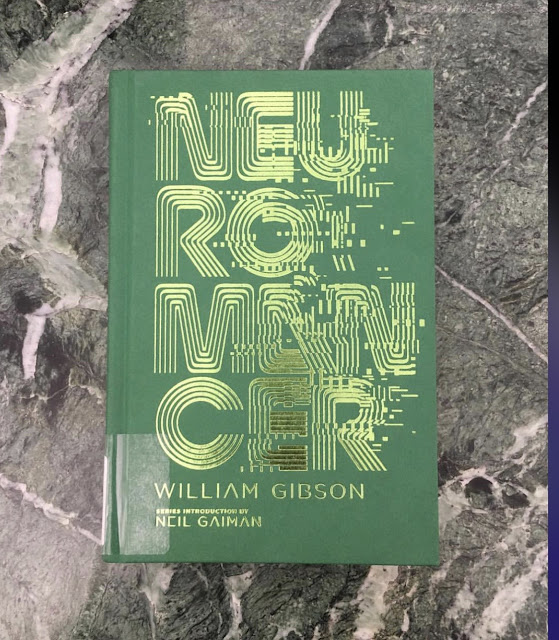
"Neuromancer" by William Gibson (published 1984)

Image
Some are familiar with Gibson's science fiction novel, "Neuromancer", now a classic (see the new, gorgeous 2016 edition from Penguin, complete with an inspiring introduction from Neil Gaiman), because it predicted the internet before the internet was invented. "Neuromancer", published in 1984, is a text that also depicts humanity's addiction to technology, a relationship that becomes indistinguishable from what is known as reality. These are two great reasons why the novel should be highly noted, but not the reason why the book should become, in my eyes, a Great Book, a Classic, a Literary Masterpiece, that should, perhaps, be required reading centuries from now, taught by professors and doctors hired by universities.  My Goodreads review gives "Neuromancer" four stars, and not the highest, five, because it is, I believe, not entirely accessible. The book is not easy to read, and I don't think it should be, even to the expense of less com...

"Two Of Six: A Captain's Dilemma" by Tomohito Moriyama, translated by J.D. Wisgo (published 2018)

Image
This fast-paced yet contemplative thriller by Japanese writer Tomohito Moriyama and translated into English by J.D. Wisgo brings up all the best topics and themes in excellent science fiction: artificial intelligence, duty vs. personal inclinations, euthanasia, paranoia, and all kinds of questions regarding human nature itself. Two Of Six: A Captain’s Dilemma tells the story of the captain of a spaceship carrying six passengers. When the spaceship malfunctions and starts losing its supply of oxygen, how does the captain decide which passengers should take the extra spacecraft back home, a spacecraft which can only save two people? The captain’s only close companion is the A.I. robot assigned to work with him. How does she influence his decisions? And, as A.I., is she capable of making purely objective decisions? Moriyama, influenced by Isaac Asimov, writes a compelling plot-driven story putting philosophy in action. Though Two Of Six does not provide rich visual landsc...

"A Wrinkle In Time" by Madeleine L'Engle (published 1962)

Image
Newbery Award winning classic children’s story, “A Wrinkle In Time” (1962), by Madeleine L’Engle, is a delightful science fiction and fantasy tale incorporating very real scientific concepts such as a *tesseract* (geometry: the generalization of a cube to four dimensions). To *tesser* means to travel beyond the rules of time and space, which is exactly what Meg, her brother Charles Wallace, her father, a friend named Calvin, and three old women (Mrs. Whatsit, Mrs. Who, and Mrs. Which), do to save one another from being incorporated into a dark planet far from home called Camazotz.  “A Wrinkle In Time” is not quite *hard* sci-fi (concerned by actual scientific accuracy), nor is it necessarily dystopian, although it steers close to both. L’Engle sprinkles a good amount of fantasy elements (such as Charles Wallace’s powers of intelligence and the angelic-like qualities of Mrs. Whatsit, Mrs. Who, and Mrs. Which), offering a brilliant escape from the mundane into a world both fright...

"The Girl Who Drank The Moon" by Kelly Barnhill (published 2016)

Image
“The Girl Who Drank The Moon” by Kelly Barnhill (2016), winner of the Newbery Medal, is one of the best books I’ve read this year. Although “The Girl Who Drank The Moon” is geared towards kids in about fifth grade, I, at thirty, loved reading this book and was fully engaged with the story, racing towards the end to find out the fate of the characters within the book. Barnhill mixes bits of alchemy, folklore, politics, romance, psychology, adventure, and horror in her fairy-tale, which is all wonderfully expected. But, as New York Times reviewer Diana Wagman has put it, “Many books we read when we’re young want to teach us lessons about life. True, the things we learn in them can stay with us forever. But lessons can be so dull. Luckily, Kelly Barnhill’s wonderful fourth novel, ‘The Girl Who Drank The Moon,’ educates about oppression, blind allegiance and challenging the status quo while immersing the reader in an exhilarating story full of magical creatures and derring-do.” The gir...

"Roadside Picnic" by Arkady and Boris Strugatsky (published 1972)

Image
“Roadside Picnic”, by Arkady and Boris Strugatsky, was originally published in 1972. It is the book that Andrei Tarkovsky’s cult classic movie, “Stalker” (1979), is based off. The story describes a Planet Earth made strange by the visit and quick departure of an unknown alien race. The title – “Roadside Picnic” – comes from the idea of a family picnic, in which the family has its blanket and foods (sandwiches, containers, baskets, grapes, cigarettes, wine, etc.) while the animals – the squirrels and the deer, etc - watch from behind bushes and trees. The family abruptly leaves, not picking up after themselves, leaving their trash and litter behind. In the book, two of the main characters liken the alien visit to the roadside picnic. What the aliens leave behind after their picnic are objects so technologically advanced no one really understands how any of it works (such as a ring that, once spun, never stops spinning), as well as strange pockets of time and even stranger sp...

"Cinder" by Marissa Meyer (published 2012)

Image
In Marissa Meyer’s “Cinder”, older literary versions of the “Cinderella” story are thrown into a future science fiction world, where Cinder is about half-human and half-cyborg (machine), and is also something else… something mysterious that only one person on Earth knows. Other than being a mechanic fixing pretty much any technological object in New Beijing, she thinks she is nobody but a dirt covered, grease stained abomination. But looks can be deceiving. What is really underneath the metal and flesh? As New Beijing collapses under a plague called letumosis, Cinder discovers the truth about her history, and perhaps the fate of the Earth. “Cinder” is a real page-turner. Much of Meyer’s writing reminds me of William Gibson (author of “Neuromancer”), but unlike his heavily stylized and conceptual writing (which is amazing), Meyer manages to tell a sharp, straightforward sci-fi tale that doesn’t have the reader reaching for meaning but rather, (hopefully) has the reader desperately ...