Posts

Showing posts with the label poems

"Old Possum's Book of Practical Cats" by T.S. Eliot (published 1939)

Image
Reminiscent in style of Ludwig Bemelmans' "Madeline" children's books and an obvious source of inspiration for the Broadway musical "CATS", "Old Possum's Book of Practical Cats" by T.S. Eliot is a complete riot. I don't know how *practical* the cats presented within these humorous poems really are, but most of them are wizened, playful, and shrewd observers of the world. Eliot's cats are mostly street cats, who are somehow both feral and domesticated at once. Their names (Rumpleteaser and Macavity, to name only two) and doings are very funny, and Edward Gorey's drawings of these cats are even funnier: cats mocking what it is to be human - and - fully clothed. Suffice it to say, "Old Possum's Book of Practical Cats" is a pleasure to read and would be really fun to read out loud too, even to children, if you don't mind the mention of alcohol and some scheming escapades of mischievous cats, including theft. More ...

"The Last Usable Hour" by Deborah Landau (published 2011)

Image
In a world of scrolling, where I am constantly reading more of the same, unimpressive, kind but not potent, charming but not soulful stuff, stuck amidst the Lang Leavs, Rupi Kaurs, and Nayyirah Waheeds (sorry, not sorry, in my humble opinion only)... Deborah Landau's small book of poetry, "The Last Usable Hour" struck a resonant, harmonious chord with me. There's not too much to *see* in this book. Her poems are textured emotionally and are sparsely descriptive. Sometimes she seems to be talking to herself ("What the hell do you think you're doing?), at just the tip of a certain kind of madness. She remembers little things people say, just a line or two, or how they seemed ("Across the table his mind right there... behind his talking face") she thinks things to herself that conflict with what is actually happening, she's distracted yet not, sometimes stuck in trains of thought, and always drawn in by desire. What is this desire? It's not...

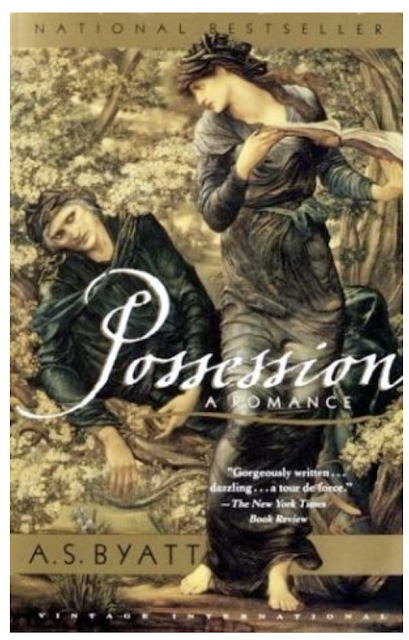
"Possession" by A.S. Byatt (published 1990)

Image
A work of art can be understood as something to one, and something completely different to another. And then, it means something to the author. Sometimes there is a line of clarity, where everyone agrees, and other times the ideas produced by a work are so vastly different that we wonder how to make sense of it at all. We all know and have felt this frenzied state of interpretation. Moreover, we go back to old and new pieces time and time again; a song, a book, a poem, a painting, and as we experience it there is another realization: that time itself has changed the thing, placing it into newer, broader categories of meaning and truth. A.S. Byatt's Possession , winner of the Man Booker Prize in 1990, is a perfect representation of that kaleidoscopic manifestation of art, lived by its creator and then posthumously, and then into academic elucidation. The story, which claims many voices, is mastered by the study of what begins as a singular poet: Randolph Henry Ash. The stud...

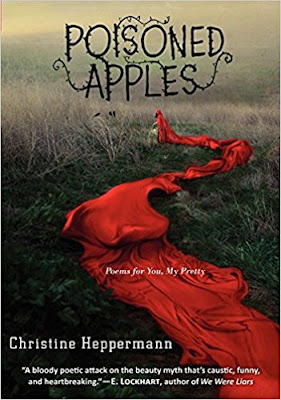
"Poisoned Apples: Poems For You My Pretty" by Christine Hepperman (published 2014)

Image
I laughed out loud, hard, a few times while reading this amazing book of poetry. I read the poems out loud too, in disbelief of the striking truth of the words, and the sadness within them as well. Everyone who has ever had to grow up will most probably be very moved by this book, especially those who have some knowledge of fairy tales. In them are words that reveal the ridiculousness of the image of "beauty" imposed on us in modern times, the tragedy of awful, selfish people that come off as being our friends, or worse, our best friends or our boyfriends, and the trauma that comes with being a teenager in a society that values outsides rather than insides and lust over love. There are more mysterious poems included as well that ask... who am I... *really*? After reading "Poisoned Apples: Poems For You My Pretty", you just might want to take the advice the author, Christine Heppermann, gives at the end: "Retell your own stories. Keep pushing your way throug...

Ovid's "Metamorphoses"

Image
“My purpose is to tell of bodies which have been transformed into shapes of a different kind... and spin an unbroken thread of verse” – from Ovid's “Metamorphoses” Ovid’s “Metamorphoses”, first published in 8 AD, is sometimes considered an epic, an epic poem, mythology, legend, or even a fairy-tale or a piece of folklore. Most have agreed that this literary work defies genre. “Metamorphoses” encompasses all the literary descriptions listed above, and is essentially a world-building composition that tells over two-hundred and fifty stories of transformation – transformations of mortals and gods alike – into elements of nature such as plants, animals, and other phenomena. Ovid, born in 43 BC, is an Italian storyteller, and today, it is still a mystery as to why he died in exile from Rome. His “Metamorphoses” contains re-tellings from the Latin and Greek tradition.  For most people who read this text, a lot of names will be familiar, such as the goddess Diana, Hercules, Arachne, K...