Posts

Showing posts with the label contemporary literature

"Daughter from the Dark" by Marina & Sergey Dyachenko (published 2020)

Image
There is a possibility that  Daughter from the Dark  by Marina & Sergey Dyachenko (2020) lost some of its stylistic panach because of its translation into English from Russian. If so, it's a big loss for the novel because its structure is so well conceived as a warpy fairy-tale and contemporary fantasy about a young girl-child from another world and the male stranger who, upon once saving her life, acts  in loco parentis.  The child herself, Alyona, cannot fully explain who she is, where she is from, and why she has no where else to go. Grimalsky, a.k.a. DJ Aspirin, her caretaker (though he treats her with less care than he probably should), teeters between awe, respect, and selfless love on one hand, and on the other, hatred, absolute annoyance, and obligation: not a good sign when the person who is supposed to be your father has no idea how to act except passive-aggressively. This mix of the two brings up a very strange Beauty and the Beast tale, where two...

"The Bear and the Nightingale" (Winternight Trilology #1) by Katherine Arden (published 2017)

Image
"He knew what evil lay upon this land. It was in the sun-symbols on the nurse's apron, in that stupid woman's terror, in the fey, feral eyes of Pyotr's elder daughter. The place was infested with demons: the chyerti of the old religion. These foolish, wild people worshipped God by day and the old gods in secret; they tried to walk both paths at once and made themselves base in the sight of the Father. No wonder evil had to come to work its mischief." (p. 113) This passage, found one third a way into Katherine Arden's  The Bear and the Nightingale  (2017), tells of Konstantin, a monk from Moscow, visiting a small village on the outskirts of the kingdom. Konstantin believes he has a mission, a "duty", to save the village people from pagan beliefs and folkloric tradition, but, as the story goes, the collision of God and duty alongside enchantment and magic just make the sum of all parts a more potent whole. Though this story is set in Russia at...

"The Loss of All Lost Things: Stories" by Amina Gautier (published 2016)

Image
The Loss of All Lost Things: Stories is a collection of fifteen short stories by Amina Gautier published in 2016. Each of the stories were featured in other publications, separately, before being collected and placed together within this evocative and meditative book. All of the stories, as you may have guessed, reflect on initial reactions, emotional and/or physical, that affect those who must come to terms, whether or not they'd like to, with loss. The losses in this book range from the disappearance of a child, the separation between partners, the dissolution of trust, the emigration of a family from a community, the broken bridge between friends, death itself... and so much more. Amina Gautier writes from an African-American perspective, offering words that share a glimpse into a world teetering on the edge of a particular subjective vulnerability, yet with such substance that I, while reading, had no doubt that I was secure in her worlds; I was on the inside, looking out. ...

"The Silk Road" by Kathryn Davis (published 2019)

Image
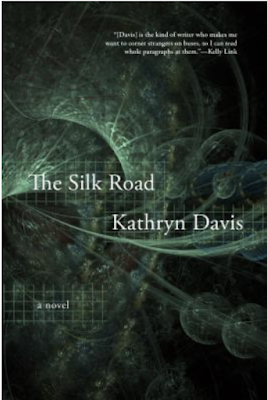
The Silk Road  is set within an interstitial place, somewhere between dream and reality, between the conscious and unconscious, in between anything that allows for something to fit within it. Reading Kathryn Davis' writing in this novel is like falling asleep to music or the sound of conversation; as the mind drifts into deep sleep, the real auditory sounds produce images in the mind - dreams - and the words or music one hears begins to blur within the subconscious of the sleeping mind. As you might be able to guess from what I've written so far, you might be able to tell that the narrative and plot of The Silk Road is not formal, and neither are any other parts of the story, save maybe the characters. "When you arrive at the edge of the world you stop remembering things like how you got there. Your attention keeps pouring over the edge, out and away from the footprints left behind you in the snow, unable to focus on anything except the cove of sparkling light there a...

"All the Fierce Tethers" by Lia Purpura (published 2019)

Image
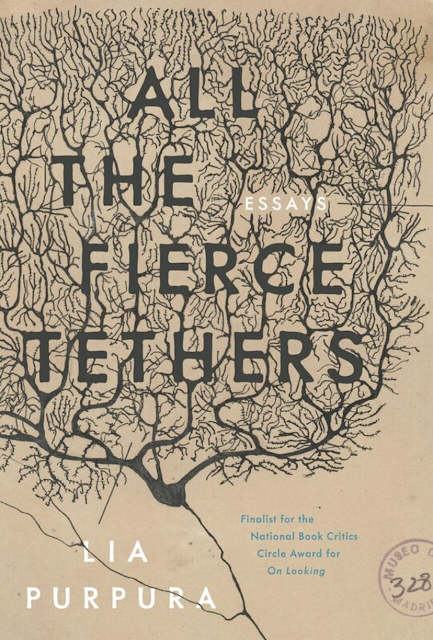
There is an immediate sense of Lia Purpura's poetic intellectualism presented right within the first page of "All the Fierce Tethers". She begins with an analysis of screaming: what it is and what it is not, what it consists of, its meaning or lack of it. Then Purpura goes right into Edvard Munch's "The Scream". There is much more to this first essay, but already within these two topics she uses Deconstruction as a philosophical tool and then begins to present examples of what Walter Benjamin wrote about in his brilliant, seminal essay, "The Work of Art in the Age of Mechanical Reproduction" (i.e. Edvard Munch's "The Scream" reproduced on magnets, on coffee mugs, on blankets. Where does its meaning - as a work of art - go? There is an important *lack* to be understood.) Whether Purpura knew whether or not she was doing what I say she is doing doesn't really matter. It doesn't matter because "All the Fierce Tether...

"Submergence" by J.M. Ledgard (published 2011) - SECOND review.

Image
My first review can be located here:  https://feliciareviewsbooks.blogspot.com/2018/07/submergence-by-jm-ledgard-published-2011.html Here's my second. An undergraduate professor of mine instructed me once on the act of reading. If you like the book, she said, and have only read it once, you have not *read* the book. If you liked it the first time, she continued, then read it a second. Then, read it again for a third and perhaps final time. Only after that can you truly decide if you liked it.  I've read Submergence for the second time and have confirmed that I do like it. Very much so. While I understand this technique isn't possible for all books, it already says something if you decide to read a book for a second time, knowing there is still more to see, to understand. (Also, my prof. was speaking as a philosopher, and you know how they are :) My point - which was/is my professors - will demonstrate itself if you glance through my first review and then read this o...

"Possession" by A.S. Byatt (published 1990)

Image
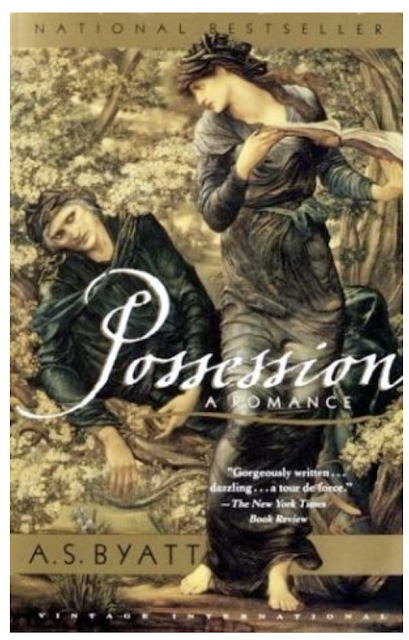
A work of art can be understood as something to one, and something completely different to another. And then, it means something to the author. Sometimes there is a line of clarity, where everyone agrees, and other times the ideas produced by a work are so vastly different that we wonder how to make sense of it at all. We all know and have felt this frenzied state of interpretation. Moreover, we go back to old and new pieces time and time again; a song, a book, a poem, a painting, and as we experience it there is another realization: that time itself has changed the thing, placing it into newer, broader categories of meaning and truth. A.S. Byatt's Possession , winner of the Man Booker Prize in 1990, is a perfect representation of that kaleidoscopic manifestation of art, lived by its creator and then posthumously, and then into academic elucidation. The story, which claims many voices, is mastered by the study of what begins as a singular poet: Randolph Henry Ash. The stud...

"The Readers Of The Broken Wheel Recommend" by Katarina Bivald (2015)

Image
The best thing about Katarina Bivald’s “The Readers Of The Broken Wheel Recommend” (2015) is that it is a book about two book lovers who don’t even realize that they love the world and their community even more than they love the books themselves. Amy, a woman from rural Iowa, more specifically, a run-down impoverished town in middle America, and Sara, a sweet and shy girl from Sweden, actually never get to meet. Instead, they are pen pals, and when Sara finally reaches Broken Wheel, Iowa to meet her, Amy is dead.  But back to the previous point: what is it about books that makes them so special? It doesn’t matter what you read. Isn’t the answer that books provide a view into a world different than our own? Where we learn about people or persons that reflect us and our inner yearnings or else teach us why and how each individual inhabits this life in completely new and unexpected ways? “Readers Of The Broken Wheel Recommend” shows us how books somehow always had to begin wi...