Posts

Showing posts with the label classic literature

"The Time Machine" by H.G. Wells (published 1895)

Image
The first line in the Epilogue of H.G. Wells' The Time Machine (1895) is as follows: "One cannot choose, but wonder." Other than how apt a reflection of the Time Traveller's story as well as the main narrator's and how humble an acceptance, how gracious a plea this is, it is also a main marker of the kind of science fiction I enjoy: whether or not one is presented with proven fact is not the issue. The issue is rather thinking and moreover, wondering what's become and what is to become of the story itself. This particular classic novella of science fiction begins with a request: that the Time Traveller's companions; the Medical Man, the Editor, the Psychologist, the Very Young Man, the Journalist, the Silent Man, and our narrator listen to the Time Traveller's story - with no interruptions - hear him out as if he were a professional storyteller indeed. The Time Traveller cares not whether they believe him but it is clear that he wants to tell it....

"The Awakening" by Kate Chopin (published 1899)

Image
I don't think Kate Chopin's intention with her novel, The Awakening, published in 1899, was to shock or entertain. Both reactions indeed took over the masses when the book was published. But Chopin, I believe, meant to teach, meant to illustrate an example. I also do not think that Chopin's main character, Mrs. Edna Pontillier, was one to entertain or one who wanted to. However, Mrs. Pontillier did entertain by way of beginning to perform and act out her life for herself, and herself alone. Her witnesses and acquaintances looked on with curiosity and concern, and love.  Put simply, The Awakening is a novel exploring societal values regarding women during the turn of the 19th century (1899). The lush backdrop of the Grand Isle in Louisiana only compounds the emotional turmoil the protagonist, Mrs. Edna Pontillier, finds herself coping with one oppressive summer. As a married woman with children, Mrs. Pontillier finds it difficult to express the psychological changes...

"Rebecca" by Daphne Du Maurier (published 1923)

Image
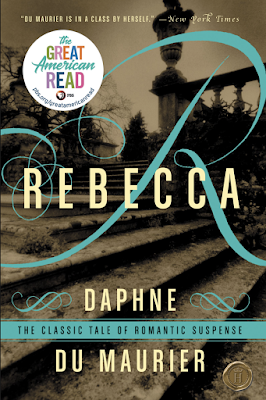
I don't think I've ever eaten as much while reading a novel as I did while reading Daphne Du Maurier's classic Rebecca, first published in 1923. Classic novel it is. Rightly so. Like the unnamed main character, I bit my by fingernails (my right pinky nail, specifically) down to the quick as I thrust pages onto the next in nervous suspense. Down went my crackers, sandwich, cookies, fried rice, chips, and dip. Down went plenty of tea, and much too much coffee, which is what is allowing me to write at this very moment when it typically is bedtime for me.  To me, Du Maurier has captured in this book not just an excellent story but a superb example of what it may be like to be borne unto the world. A birth into the first part of the 20th century, in Britain, to be sure, but a birth nonetheless. The phrase coming-of-age is much to trite for this novel. The birth is a terrible one, of shock and disbelief. The narrator is a kind of still-born (for lack of a better metapho...

"The Woman In White" by Wilkie Collins (published 1859)

Image
Wilkie Collins’ novel The Woman In White has themes that may seem cliché: love conquers all, the truth will always come out in the end, people with an air of superiority usually have something to cover up… as Alexander Pope once said, “Charms strike the sight, but merit wins the soul.” Collins’ The Woman In White proves that, and is everything but cliché. This lengthy masterpiece of a novel is part sensation novel, part mystery, part social commentary, and of course, like every good story, part romance. It is a book that probably should be read slowly so as to savor every idea and emotion offered by this talented writer. And to read this novel slowly is exactly how it was read in 19th century England, when Collins submitted his story, chapter by chapter, week by week, to Charles Dickens’ magazine, All the Year Round. Victorians consumed this novel like starving animals from the year 1859-1860. This was a time of excess and pleasure, and “grandiose” performance (Sweet, Introduction)...

"The Hobbit" by J.R.R. Tolkien

Image
The Hobbit - first of all - is a children's story about journeying. It's tone is playful even throughout the perhaps psychological and physical representations of the trauma of war (this was written between WWI and WWII) . There are huge spiders, evil trolls, and goblin battles, to name a few. These encounters that the hobbit (Bilbo Baggins), the dwarfs and elves have make them a team with the goal to retrieve the treasure that was wrongfully taken away from them (specifically from the dwarf Thorin Oakenshield) by yet another (recurring character in fantasy works) dragon, this one named Smaug. Gandalf the wizard acts as their guardian and teacher, offering kind words, advice, and support, the whole way, that is, the journey from the nice and homely place of Bag End to the dragon's lair at The Lonely Mountain. Bilbo Baggins is a naive jack-of-all-trades, even an odd-ball, and a partaker in pleasurable activities and hobbies, before he is practically pushed out of his co...

"Walden" by Henry David Thoreau (published 1854)

Image
“If you have built castles in the air, your work need not be lost; that is where they should be. Now put the foundations under them.” – Henry David Thoreau As it turns out, Henry David Thoreau, considered by many to be a quintessential American writer, is not as quaint as I may have originally believed. My initial impression of Thoreau was just that – an initial impression - which did not keep me from reading one of his most famous works, “Walden”, even when I came across his more personally disagreeable ideals. The best places to go are places where one does not have to purchase any new clothes, he writes, or the idea that one should maximize (if you will) the concept of minimalism itself. I love clothes as a form of expression as do I love objects (particularly related to artistry), so his ideas seemed *quaint* to me. However, as I started to really contemplate Thoreau’s “Walden”, it became clear that Thoreau actually set a great example in that he came at the world, and the peop...

"Jane Eyre" by Charlotte Bronte (published 1847)

Image
Charlotte Brontë’s well-known novel, Jane Eyre, was published in the year 1847, which is a time that took place during England’s Victorian Era. Brontë’s book is considered by most conventional standards as a work of Gothic Fiction, defined as a mix of fiction and horror, death and romance. Along with elements of the macabre, which make up a part of Gothic literature, there is also Gothic architecture, which defined it also as an aesthetic. Time and place are two very essential parts of understanding literature, and very literally make up the background of a well-written story. The foreground of the story is the characters and their relationships, both to one another and the larger social world they live in. Both background and foreground as presented here will be discussed and will answer two simple questions: 1) Why was Jane Eyre so important when it was published? & 2) Why is Jane Eyre still relevant today? Every era has its societal standards, its status quo. The Victorian E...

Ovid's "Metamorphoses"

Image
“My purpose is to tell of bodies which have been transformed into shapes of a different kind... and spin an unbroken thread of verse” – from Ovid's “Metamorphoses” Ovid’s “Metamorphoses”, first published in 8 AD, is sometimes considered an epic, an epic poem, mythology, legend, or even a fairy-tale or a piece of folklore. Most have agreed that this literary work defies genre. “Metamorphoses” encompasses all the literary descriptions listed above, and is essentially a world-building composition that tells over two-hundred and fifty stories of transformation – transformations of mortals and gods alike – into elements of nature such as plants, animals, and other phenomena. Ovid, born in 43 BC, is an Italian storyteller, and today, it is still a mystery as to why he died in exile from Rome. His “Metamorphoses” contains re-tellings from the Latin and Greek tradition.  For most people who read this text, a lot of names will be familiar, such as the goddess Diana, Hercules, Arachne, K...