Posts

Showing posts with the label English literature

"The Castle of Otranto" by Horace Walpole (published mid 1700s)

Image
The Castle of Otranto tends towards an absolutely ridiculous riot of personal calamities within a Sicilian house owned by the family Otranto. Yet the catastrophes within the relationships within the castle's household is so obvious, cliche even (at times resembling a soap opera, or some other television drama), a complex narrative of differing perspectives not withstanding, that Walpole's take on a medieval Italian tale is completely serious in resonance (though sometimes allowing for the occasional knowing smile, if not laughter).  The catastrophe, having to do with romances forbidden (between a prince and his daughter in law, for example), ownership of property (the heir to the castle being a peasant, for ex.), and indiscretion within the family (the bond between two maidens so strong that even their love for the same man could not break it), on and on... makes the story's revelation - perhaps an apocalyptic one - about what the subjective  idea of transgressions might d...

"The Time Machine" by H.G. Wells (published 1895)

Image
The first line in the Epilogue of H.G. Wells' The Time Machine (1895) is as follows: "One cannot choose, but wonder." Other than how apt a reflection of the Time Traveller's story as well as the main narrator's and how humble an acceptance, how gracious a plea this is, it is also a main marker of the kind of science fiction I enjoy: whether or not one is presented with proven fact is not the issue. The issue is rather thinking and moreover, wondering what's become and what is to become of the story itself. This particular classic novella of science fiction begins with a request: that the Time Traveller's companions; the Medical Man, the Editor, the Psychologist, the Very Young Man, the Journalist, the Silent Man, and our narrator listen to the Time Traveller's story - with no interruptions - hear him out as if he were a professional storyteller indeed. The Time Traveller cares not whether they believe him but it is clear that he wants to tell it....

"Rebecca" by Daphne Du Maurier (published 1923)

Image
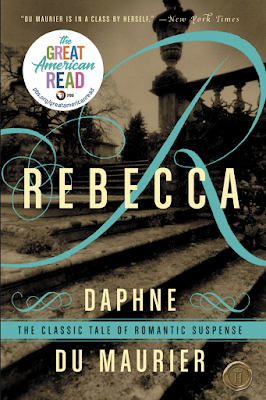
I don't think I've ever eaten as much while reading a novel as I did while reading Daphne Du Maurier's classic Rebecca, first published in 1923. Classic novel it is. Rightly so. Like the unnamed main character, I bit my by fingernails (my right pinky nail, specifically) down to the quick as I thrust pages onto the next in nervous suspense. Down went my crackers, sandwich, cookies, fried rice, chips, and dip. Down went plenty of tea, and much too much coffee, which is what is allowing me to write at this very moment when it typically is bedtime for me.  To me, Du Maurier has captured in this book not just an excellent story but a superb example of what it may be like to be borne unto the world. A birth into the first part of the 20th century, in Britain, to be sure, but a birth nonetheless. The phrase coming-of-age is much to trite for this novel. The birth is a terrible one, of shock and disbelief. The narrator is a kind of still-born (for lack of a better metapho...

"Possession" by A.S. Byatt (published 1990)

Image
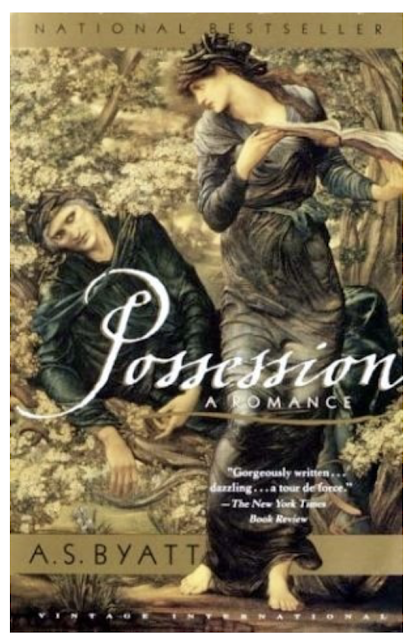
A work of art can be understood as something to one, and something completely different to another. And then, it means something to the author. Sometimes there is a line of clarity, where everyone agrees, and other times the ideas produced by a work are so vastly different that we wonder how to make sense of it at all. We all know and have felt this frenzied state of interpretation. Moreover, we go back to old and new pieces time and time again; a song, a book, a poem, a painting, and as we experience it there is another realization: that time itself has changed the thing, placing it into newer, broader categories of meaning and truth. A.S. Byatt's Possession , winner of the Man Booker Prize in 1990, is a perfect representation of that kaleidoscopic manifestation of art, lived by its creator and then posthumously, and then into academic elucidation. The story, which claims many voices, is mastered by the study of what begins as a singular poet: Randolph Henry Ash. The stud...

"The Woman In White" by Wilkie Collins (published 1859)

Image
Wilkie Collins’ novel The Woman In White has themes that may seem cliché: love conquers all, the truth will always come out in the end, people with an air of superiority usually have something to cover up… as Alexander Pope once said, “Charms strike the sight, but merit wins the soul.” Collins’ The Woman In White proves that, and is everything but cliché. This lengthy masterpiece of a novel is part sensation novel, part mystery, part social commentary, and of course, like every good story, part romance. It is a book that probably should be read slowly so as to savor every idea and emotion offered by this talented writer. And to read this novel slowly is exactly how it was read in 19th century England, when Collins submitted his story, chapter by chapter, week by week, to Charles Dickens’ magazine, All the Year Round. Victorians consumed this novel like starving animals from the year 1859-1860. This was a time of excess and pleasure, and “grandiose” performance (Sweet, Introduction)...