Posts

Showing posts with the label Japanese literature

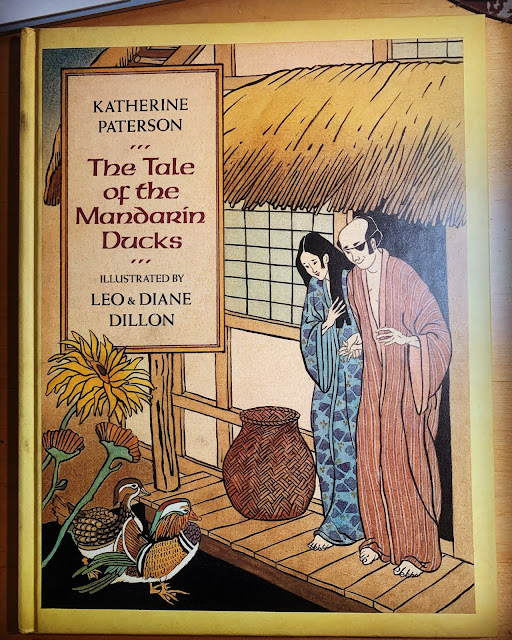
"The Tale of the Mandarin Ducks" by Katherine Paterson (Illustrated by Leo & Diane Dillon)
Image
Katherine Paterson's retelling of the classic Japanese folktale, "The Tale of the Mandarin Ducks" (1990), is perfectly encapsulated in the form of a children's picture book, with richly toned traditional illustrations (olive greens, sunflower yellows...) by Leo & Diane Dillon. In it, a masterful story of a stolen drake unfolds. Deep in nature, a beautiful, colorful drake lives with his wife. But when he is taken from his home to the lord's manor (to be on display within a cage), the drake grows weary and utterly depressed, unable to sustain himself, only thinking of his worried wife. Luckily, a sympathetic and wise person intervenes, and from there, the story blossoms into one of magic, divine oversight, and karmic fruition, all stemming from a continuous surging of two people's kindness towards the rest of the world. You'll find out how a little touch of compassion, shared by humans and animals alike, is enough to outweigh those terribly hurtful i...

"Classic Japanese Fairy-Tales: Volume II" by Mimei Ogawa, translated by J.D. Wisgo

Image
Translated from the Japanese, this collection of eight fairy-tales by Mimei Ogawa is full of delicate renderings that illuminate as well as sooth the harshness of life. How do we begin to bridge the gap between forced enemies? Or, what should we do with an enchanted remedy only good for one dose? There isn't a nice and neat ending to all of these (for example, "The Fishmonger Woman"), further supporting the theory that "happily-ever-after" is not a necessary component of the fairy-tale. Rather, the words that have been carefully translated by J.D. Wisgo from the pen of a deceased writer offers a brief and beautiful glimpse into moments of life that have been slowed down for the pleasure of contemplation. Wisgo fills each word with a sensitivity that reaches deep into an older culture that thrives today, yet is more hidden than ever before, like sketches or outlines of a world without its distractions; see "The Dog, the Man, and the Flower", just a...

"The Guest Cat" by Takashi Hiraide (published 2001)

Image
A picture of my lady cat (but always my baby cat), Grigio, and my library copy of "The Guest Cat" "The Guest Cat" (published 2001), is a book about a cat named Chibi. At first a stray wandering around in Japan, she is taken in by a little boy and his mother who live next to a sweet middle aged couple. Takashi Hiraide, the author, explains this very particular corner of Japan with wondrous detail. The couple has named this corner of town "Lightning Alley" for the way the streets curve and turn sharply and for the elements of uphill and downhill. For these geographical reasons in their quiet district, the two neighbors cannot see or even interact with one another on a regular basis. But, the cat Chibi wanders and strolls back and forth between their two houses, spending an equal amount of time in each home.  The couple, with no child of their own (the reasons remain somewhat ambiguous), develop a deep affection for Chibi. Without even picking her ...

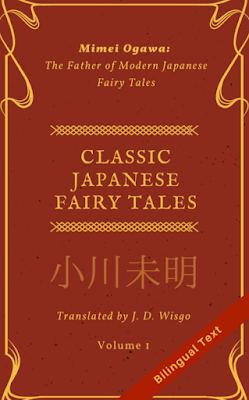
“Classic Japanese Fairy-Tales [Volume 1]: Mimei Ogawa: The Father Of Modern Japanese Fairy-Tales” by Mimei Ogawa, translated by J.D. Wisgo

Image
“Classic Japanese Fairy-Tales [Volume 1]: Mimei Ogawa: The Father Of Modern Japanese Fairy-Tales” is a new collection of Japanese fairy-tales translated into English by J.D. Wisgo (2018). This beautiful collection of six Japanese fairy-tales is precious and unique because it is the first publication of its kind: so widely available (unlike other publications of Ogawa’s) and with refreshed translations of classic tales, many of which are not widely known. Wisgo’s renderings of these stories are brilliant, extremely sensual and vivid, and full of poignant reflection without being overtly literary.  The six tales in this volume include: The Red Candle & The Mermaid, The Clockless Village, The Golden Hoops, Saffron Wine & The Desert Town, The Chocolate Candy Angel, and Many Years Later. To be sure, all of these are indeed fairy-tales (as opposed to fables). The lessons and meanings are subtle and abstract. When towns disappear is it due to bad luck or mermaids? Or, what is ...