Posts

Showing posts with the label published 1990

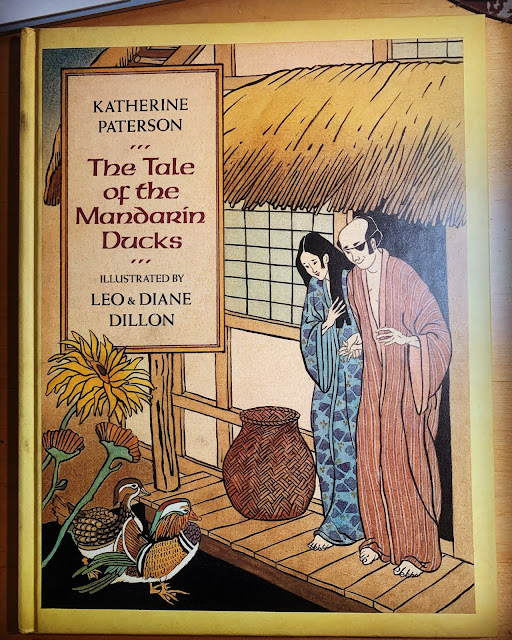
"The Tale of the Mandarin Ducks" by Katherine Paterson (Illustrated by Leo & Diane Dillon)
Image
Katherine Paterson's retelling of the classic Japanese folktale, "The Tale of the Mandarin Ducks" (1990), is perfectly encapsulated in the form of a children's picture book, with richly toned traditional illustrations (olive greens, sunflower yellows...) by Leo & Diane Dillon. In it, a masterful story of a stolen drake unfolds. Deep in nature, a beautiful, colorful drake lives with his wife. But when he is taken from his home to the lord's manor (to be on display within a cage), the drake grows weary and utterly depressed, unable to sustain himself, only thinking of his worried wife. Luckily, a sympathetic and wise person intervenes, and from there, the story blossoms into one of magic, divine oversight, and karmic fruition, all stemming from a continuous surging of two people's kindness towards the rest of the world. You'll find out how a little touch of compassion, shared by humans and animals alike, is enough to outweigh those terribly hurtful i...
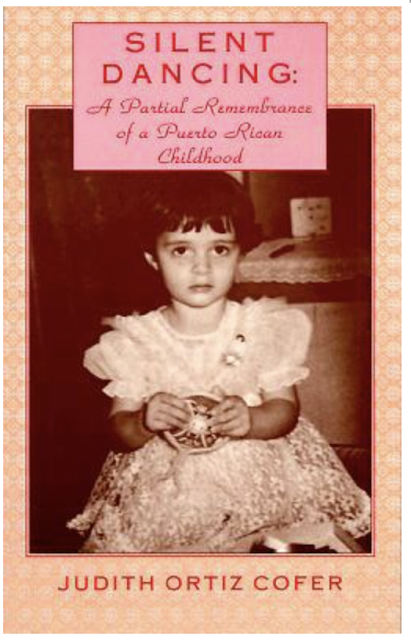
"Silent Dancing: A Partial Remembrance of a Puerto Rican Childhood" by Judith Ortiz Cofer (published 1990)

Image
The feeling of not being here - or there - with half your heart belonging to one place and the other half belonging to the other, and for completely different reasons… of wanting to live your own particular way, but having others tell you to live another particular way - this may be a roller coaster of emotions familiar to most, if not all of us. The immigrant experience, however, compounds this, no matter where you’re coming from. Silent Dancing: A Partial Remembrance Of A Puerto Rican Childhood is the autobiography of Judith Cortiz Cofer. She tells the story of her childhood lived between two cultures: Puerto Rico, her birthplace and place of familial ties, a place of rural abundance, and a city in New Jersey, where Spanish was spoken at home, and English in school, where Puerto Ricans lived cramped in old buildings abandoned by previous Italian and Irish immigrants, where a mother refused her own assimilation into American culture, but encouraged her daughter to “fit-in”. Cofer’...

"The Secret Diary of Laura Palmer" by Jennifer Lynch (published 1990)

Image
Because of the subject matter of this book, I couldn’t write a proper review (maybe I’ll be able to write one sometime in the future). What came to me instead was a short note to Laura. A bit of *fanfiction* for those who are as obsessed with Twin Peaks as I:  Dear Laura, You are wise beyond your years: you are willing to accept what most people, young and old, cannot. Your innocence was robbed from you, yes, but you have something still, a power all your own that has nothing to do with sex. I know you’re surprised. But I mean it: it has nothing to do with sex. Though I know that’s one of your favorite things :) But this has to do with your capacity, your ability, to reflect, honestly and truly, within yourself and within each of your relationships, bringing out something that bravely stands in the face of superficiality and says: “F-you. I want - I need - something deeper.” It’s all right there in your diary. Between the horror, the twisted pleasure, the games - through the s...

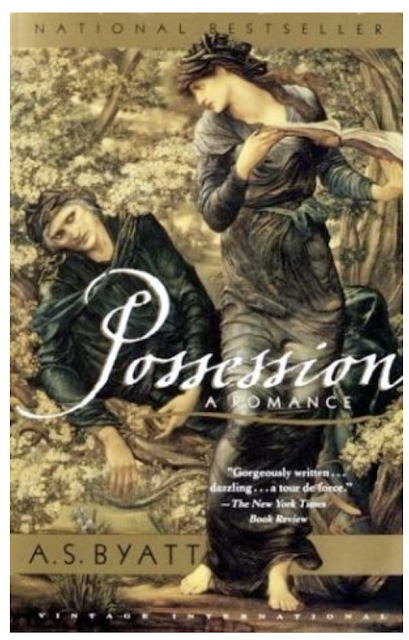
"Possession" by A.S. Byatt (published 1990)

Image
A work of art can be understood as something to one, and something completely different to another. And then, it means something to the author. Sometimes there is a line of clarity, where everyone agrees, and other times the ideas produced by a work are so vastly different that we wonder how to make sense of it at all. We all know and have felt this frenzied state of interpretation. Moreover, we go back to old and new pieces time and time again; a song, a book, a poem, a painting, and as we experience it there is another realization: that time itself has changed the thing, placing it into newer, broader categories of meaning and truth. A.S. Byatt's Possession , winner of the Man Booker Prize in 1990, is a perfect representation of that kaleidoscopic manifestation of art, lived by its creator and then posthumously, and then into academic elucidation. The story, which claims many voices, is mastered by the study of what begins as a singular poet: Randolph Henry Ash. The stud...