Posts

Showing posts with the label criticism

"Shard Cinema" by Evan Calder Williams (published 2017)
Image
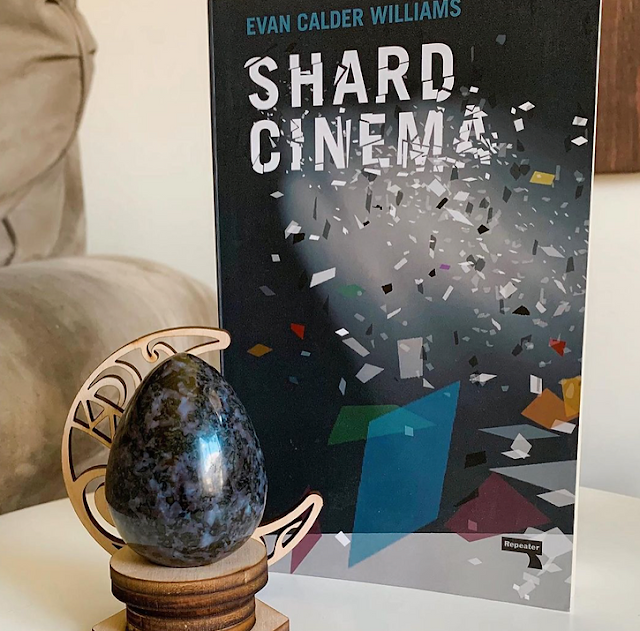
I don't know how well Shard Cinema (2017) will age compared to Williams' previous two books ( Roman Letters and Combined and Uneven Apocalypse ). However, I do think the theory he provides his readers concerning the contemporary cinematic experience is vital to new interpretations of a world that has become increasingly difficult to conceive of visually. In essence, he writes of a purely visual representation of a kind of momentary halting of time that allows for the movement of abstractions rather than the movement of actual objects; a coming into view of that which has been broken, fractured, severed, and ultimately, shattered. Most of the films he cites are blockbusters that had/have the monetary heft to show their audiences a kind of shattered imaging (it takes a whole lot of money to digitally produce the effect). Interestingly, it seems Williams understands these moments of gradual breakdown - the shift of perspective from "landscape" (or cityscape, etc.) to ...

"Ways of Seeing" by John Berger (published 1972)

  While reading Berger's Ways of Seeing for the second time in many years, I reacted less by noting how obvious Berger's arguments were and more by realizing that the text has become somewhat dated. The technology that exists today, especially since the advent of the internet and social media, has become insidiously nuanced and Ways of Seeing had no way to predict that kind of capital evolution in terms of the creation of new ways to exploit the poor through reproduced images, i.e. how advertising now sways the public by manipulating and playing with its fears - if not so much anymore its envy. However, Berger's classic remains a seminal text within Cultural Studies and Critical Theory. Berger explains how society has been affected by the transformation of artistic technology, from oil painting, to the camera, to publicity advertising in the modern world, and how that transformation feeds on itself as a way to stabilize and defend the values and ideologies of the wealth...

"Roman Letters" by Evan Calder Williams (published 2011)

Image
To put it lightly: every time I've picked up "Roman Letters" since its publication I've been reminded that I'm fully alive, not quite dead yet, and that I hate it. And yet, it is precisely the letters in this book that have urged me continue on, despite all my illnesses, mental and physical, and all the disgusting politics that go with that. With steady words, the stories Williams tells throughout this masterpiece of a text convince me that maybe it's not so bad, maybe it's completely OK to go on living with this hatred of my existence; moreover, that it is necessary for me to unpack what's there, to go in deep into that emptiness, and, for the sake it, become that gorgeous thing like Williams' Napoli... that Italian city that he traverses (Rome and Bologna among others)... a city that is gorgeous, "gut-clenching gorgeous, because it has stopped caring whether or not it exists, but still it does." (81) "Roman Letters" is the ...

"Sontag: Her Life and Work" by Benjamin Moser (published 2019)

Image
Who is Susan Sontag? You may have heard her name before. The first time I heard her name was as an undergraduate at Columbia College Chicago while pursuing my Bachelor's Degree in Cultural Studies, probably around 2007. The class was assigned to read Notes on Camp  . I'm not sure I understood then, as I'm not so sure I understand it now, but this is what fascinated me: that an intellectual, an intellectual woman, was writing about culture, specifically commercial  culture in a completely unique way, opening up the realm of criticism to daily observance, witticism, and playful wisdom. At that time, the big buzz around her may have died down, though I doubt it. This was the first time I truly engaged in academia beyond the high school classroom, and the only high school classrooms I cared about were Music, Biology and English. So I had no access to this world up until this point. What I'm getting at: Susan Sontag was never a celebrity to me, I did not have preconceiv...

"Regarding the Pain of Others" by Susan Sontag (published 2003)

Image
This is not a review, but more of a synopsis of Susan Sontag’s 2003 book titled “Regarding the Pain of Others”. Highlighted within it are points that I believe to be the most important particularly for figuring out how to think about news in recent years, something that has become more of a problem for me as I’ve matured. A topic that I couldn’t fit into this is regarding advertising images (“Advertising photographs are often just as ambitious, artful, slyly casual, transgressive, ironic, and solemn as art photography”).  In “Regarding the Pain of Others”, Susan Sontag (1933 – 2004) writes about the phenomenon of photography in relation to documenting war. While painting and other forms of art are understood as the creator’s interpretation of the violence of war (for example, Goya did not paint from life, but conjured up the image of war from his experience and view of it: terrible, violent, earth-shattering), the photograph is typically seen as evidence, regarded as matter-of...

"The Pleasure of the Text" by Roland Barthes (published 1975)

Image
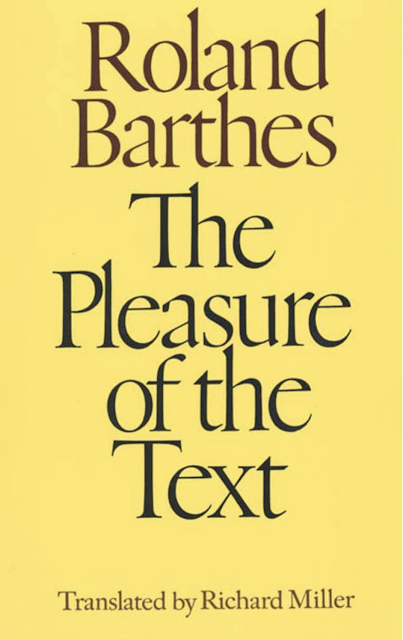
Many parts I know I love, many parts I know I don't yet understand. A lot has to do with the undoing of jargon (first to understand the jargon, then to throw it away), so as to make room for things *as is*, finally allowing for a plurality of meaning. This was translated from French and you can tell. It's part of its charm. A book to be read again and again and again. Other than that, I'm speechless.

"Combined and Uneven Apocalypse" by Evan Calder Williams (published 2011)

Image
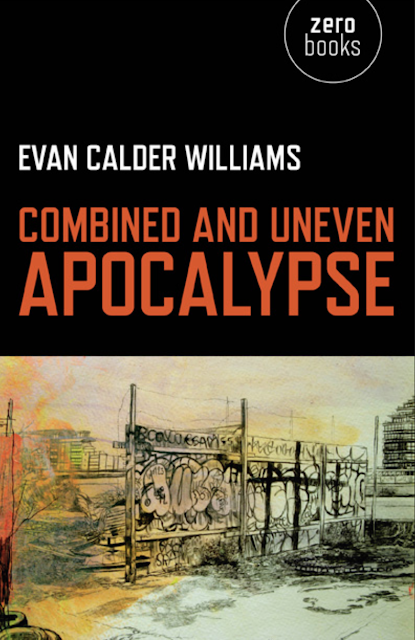
Similar in its practical (or tactical, whichever you prefer) aim to perhaps John Berger's " Ways of Seeing"  (1972), Evan Calder Williams' " Combined and Uneven Apocalypse" (2011) lays bare a different understanding of the world: a world in which its subjects can no longer point beyond themselves to any given cause. The apocalypse is here, it has been, and it will be. So now what? First, Williams really wants us to get a handle on what the apocalyptic actually is - on his terms - so that we can understand what it means to become  post-apocalyptic : "... post apocalyptic here does not mean that we have witnessed the destruction of our society or nation. It means what we don't know who are enemies are anymore. The very category of enemy is rendered diffuse, reduced to the bad smell of fear stinking up the place." (p. 55) Williams is interested in the literature, language, and filmic readings of zombie films, films about catastrophe, the t...

"The Fairy Tale: The Magic Mirror of Imagination" by Steven Swann Jones (published 1995)

Image
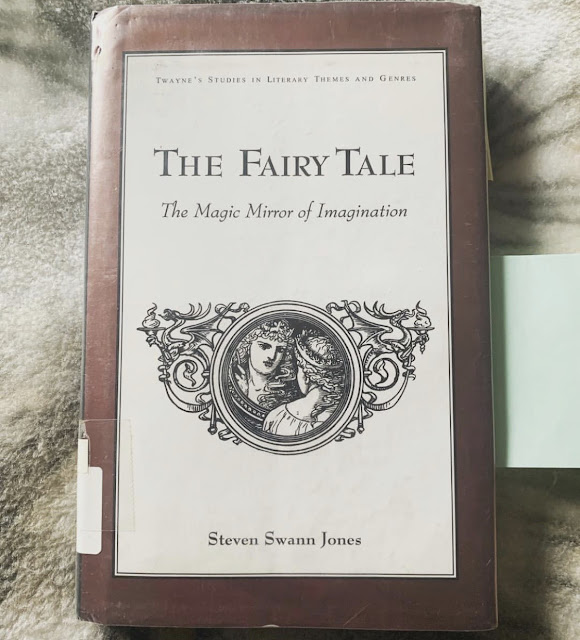
Steven Swann Jones' "The Fairy Tale: The Magic Mirror of Imagination" is a great beginner's introduction to the fairy tale genre. While much of his criticism stresses what seems to me "dated" (actually the book is a bit dated for this field) concerns regarding the fairy tale - the regulation of female protagonists to domestic duties under the patriarchy, for example - I really learned a lot about the fairy tale genre as being a form of story exemplary of the "common" person, the "regular" man or woman, the "ordinary". I'd say I, for the most part, agree. Swann Jones makes clear that fairy tales usually feature a main character who isn't *special* in any particular way and under enormous social pressure as well. My response to both these criticisms is this: how can we find a way to understand the fairy tale story as a way of expressing the *extraordinary* tasks of women (whether in the domestic sphere or otherwise)? ...

"Submergence" by J.M. Ledgard (published 2011) - SECOND review.

Image
My first review can be located here:  https://feliciareviewsbooks.blogspot.com/2018/07/submergence-by-jm-ledgard-published-2011.html Here's my second. An undergraduate professor of mine instructed me once on the act of reading. If you like the book, she said, and have only read it once, you have not *read* the book. If you liked it the first time, she continued, then read it a second. Then, read it again for a third and perhaps final time. Only after that can you truly decide if you liked it.  I've read Submergence for the second time and have confirmed that I do like it. Very much so. While I understand this technique isn't possible for all books, it already says something if you decide to read a book for a second time, knowing there is still more to see, to understand. (Also, my prof. was speaking as a philosopher, and you know how they are :) My point - which was/is my professors - will demonstrate itself if you glance through my first review and then read this o...

"An Open Letter To Those Who Condemn Looting" by Evan Calder Williams (2011)

Image
(Listen to the audio version of this letter read by Resonance Audio) My short review:  A powerful and passionate letter to all of us in these times of riot, rebellion, and mayhem. Instead of seeing those who dissent the perpetuation of classicism and racism, particularly by the hands of the police, as apart from the whole (indeed, of humanity), Williams asks us, in well reasoned vexation, to take notice of our blind spots and understand how to fathom these chaotic rebellions as natural responses to injustice, greed, and ignorance. Whether you are part of the rebellion or one who witnesses the death and destruction from your velvet couch, the point here is not so much an urge for you to dis/continue setting fires or to move from your meditative position in order to stoke it, but rather to consider the actions leading up to such hellish disruption; a consideration that hopefully leads to a connective point disavowing all the structures set in place that makes class and rac...