Posts

Showing posts with the label memoir

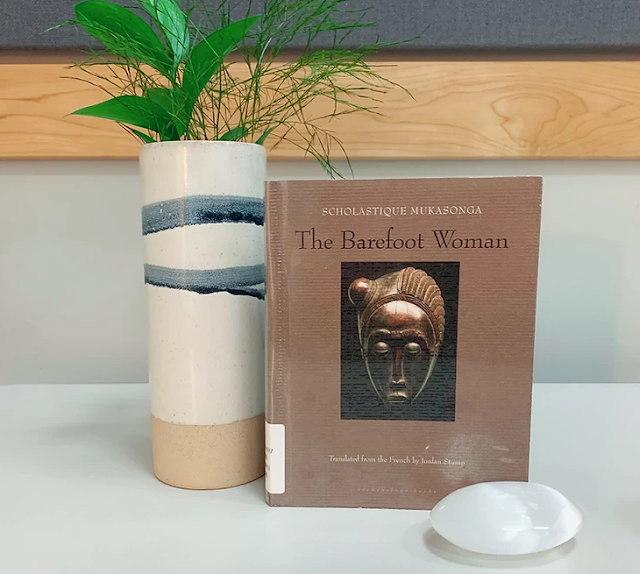
"The Barefoot Woman" by Scholastique Mukasonga (published 2018)
Image
  The Barefoot Woman - a title not referring to woman, singular, as suggested grammatically, but instead to a pluralism of each woman whose life has traversed Rwanda, and Africa more generally... the numerous who have walked and worked, loved and cared, by the wounded and hardened soles of their feet. Deeply transformative, the memoir is subtly theatrical, depicting, scene-by-scene, the daily lives of the children, women, and men affected by the violence in Rwanda. The story's hand does not fall heavy on historical detail or context, but instead fills the narrative with full, brilliant, and vibrant evocations of Mukasonga's growing years: her mother's building of a traditional inzu behind their house, the cultivation of precious sorghum and other crops, the tending of feet (and how her mother tried to give her toes "eyes" to soften the blows, to no avail), the delicate and rambunctious process of marriage proposals, the comparison of gorgeous women to the worship...

"They Called Us Enemy" by George Takei (published 2019)

Image
George Takei's graphic novel - illustrated by Harmony Becker and co-written with Justin Eisinger and Steven Scott - is an important entry into American history that, for the most part, has not been delved into at depth (and very much should be). Takei's graphic novel, They Called Us Enemy , chronicles his life's memory beginning with a short childhood spent in California and then only a little bit later, the rest of his childhood spent in Japanese Internment Camps set-up by the U.S. government during World War II due to a attack on Pearl Harbor by the Japanese government. Takei's journey is an astounding glimpse into a world fraught with racial politics; the problems with defining people, especially immigrants, by their ethnicity, and the extreme, wieldy, power an unlawful government has to wreak havoc on a person's identity, physical and mental, by means of vocabulary (images of the wartime propaganda are shown), ideological impositions on/of "law" (the j...

"The Diary of Frida Kahlo: An Intimate Self-Portrait" by Frida Kahlo (published 2005)

Image
Reading “The Diary Of Frida Kahlo: An Intimate Self-Portrait” is a perfect way to become acquainted with one of the most renowned artists of all time. First, Carlos Fuentes’ introduction gives insightful and well-researched information on the socio-political backdrop of Mexico during Kahlo’s life (1907 – 1954), shedding light on the importance of Frida Kahlo’s work on Mexican culture and history. Fuentes looks into the syncretic nature of Mexico, making symbolic connections to Kahlo’s art, some intended by Kahlo, some not. The physical body of Frida Kahlo (broken and sick since a tragic accident when Kahlo was eighteen), visualizes the trauma of Mexican heritage, also broken through colonization. Like Frida, Mexico is fractured, a national identity both influenced and torn apart by outside forces.  Perhaps some may still argue that these types of introductions are no longer necessary to appreciate an artist’s work, and that the art can stand apart from any kind of context. Esp...

"Between The World And Me" by Ta-Nehisi Coates

Image
“…assertions skate over the very real — and still dismally insufficient — progress that has been made… in fact, his book often reads like an internal dialogue or debate…” – Michiko Kakutani (New York Times – July 2015) “The narrative focuses the experience of black subjectivity in the visceral, constructed fact of ‘the body’, a device derived from Foucault by way of feminist discourse… Coates admits that he didn’t really know any white people when he was a child: he only saw them on television. That is an indictment of the segregation that still exists in many American neighbourhoods…” – Thomas Chatterton Williams, “Loaded Dice” (London Review Of Books – December 2015) “Between The World And Me” by Ta-Nehisi Coates is the second book I’ve read by a black man. The first book I read about black life in America was Richard Wright’s “Black Boy”. The two offer very different perspectives. Wright’s first person autobiographical narrative describes his childhood through adulthood as a haz...

“Educated: A Memoir” by Tara Westover (published 2018)

Image
“Educated: A Memoir” by Tara Westover, is the harrowing account of one girl’s journey in rebuilding herself as an individual apart from the girl who was emotionally and physically abused during childhood and teenage years. It was Tara Westover’s biological family, who prided themselves on an extreme form self-sufficiency and self-reliance that claimed all government ties as work of the devil, who perpetrated this abuse. Despite this, Tara’s early years were not without beauty. Growing up next to a massive mountain her family nicknamed “The Indian Princess” for its changing colors during the warmer seasons, rural Idaho was an almost sacred landscape to roam wild and free in, as well as a grand backdrop to contemplate existence itself: “Of course I *did* exist. I had grown up preparing for the Days Of Abomination, watching for the sun to darken, for the moon to drip as if with blood. I spent my summers bottling peaches and my winters rotating supplies. When the World Of Men f...