Posts

Showing posts with the label art

"Ways of Seeing" by John Berger (published 1972)

  While reading Berger's Ways of Seeing for the second time in many years, I reacted less by noting how obvious Berger's arguments were and more by realizing that the text has become somewhat dated. The technology that exists today, especially since the advent of the internet and social media, has become insidiously nuanced and Ways of Seeing had no way to predict that kind of capital evolution in terms of the creation of new ways to exploit the poor through reproduced images, i.e. how advertising now sways the public by manipulating and playing with its fears - if not so much anymore its envy. However, Berger's classic remains a seminal text within Cultural Studies and Critical Theory. Berger explains how society has been affected by the transformation of artistic technology, from oil painting, to the camera, to publicity advertising in the modern world, and how that transformation feeds on itself as a way to stabilize and defend the values and ideologies of the wealth...

"The Diary of Frida Kahlo: An Intimate Self-Portrait" by Frida Kahlo (published 2005)

Image
Reading “The Diary Of Frida Kahlo: An Intimate Self-Portrait” is a perfect way to become acquainted with one of the most renowned artists of all time. First, Carlos Fuentes’ introduction gives insightful and well-researched information on the socio-political backdrop of Mexico during Kahlo’s life (1907 – 1954), shedding light on the importance of Frida Kahlo’s work on Mexican culture and history. Fuentes looks into the syncretic nature of Mexico, making symbolic connections to Kahlo’s art, some intended by Kahlo, some not. The physical body of Frida Kahlo (broken and sick since a tragic accident when Kahlo was eighteen), visualizes the trauma of Mexican heritage, also broken through colonization. Like Frida, Mexico is fractured, a national identity both influenced and torn apart by outside forces.  Perhaps some may still argue that these types of introductions are no longer necessary to appreciate an artist’s work, and that the art can stand apart from any kind of context. Esp...

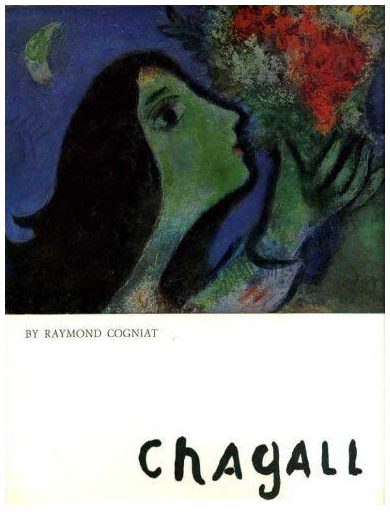
"Chagall" by Raymond Cogniat (published 1985)

Image
If you are not too familiar with Marc Chagall's work, "Chagall" by Raymond Cogniat (1985) is a good place to begin. The "America Windows", the beautiful blue stained glass windows gifted to Chicago for the bicentennial in 1977 and now located at the Art Institute of Chicago, is the piece of artwork that attracted me to this artist first and foremost:  https://www.artic.edu/artworks/109439... My personal interest springs from that middle panel: a wand, held up between what looks like the sun and moon, a floating book, the cityscape below in all its pretty treachery, the purple bird, a bit of green, a table. Elegantly simple in subject matter, at least seemingly, those windows can be looked at for quite some time. They penetrate into the viewer, engulf them in its blue, making the city feel more whole and less fragmented. As Cogniat writes of Chagall's stained glass: "...in his stained glass the wall itself vanishes and the whole interior is fi...

"Hold Still: A Memoir With Photographs" by Sally Mann (published 2015)

Image
“Hold Still: A Memoir With Photographs” is the gripping true story of Sally Mann, the renowned American photographer. While some may not have heard of her yet, reading this book, which recently won the Andrew Carnegie Medal For Excellence In Nonfiction (2016), more than suffices as an introduction to her work. There are four parts to the book, each of which ties in her life and philosophy and how these have informed her art. It is fascinating to read Sally Mann’s skillfully and beautifully written account of her childhood: her unconventional parents and her love for horses, her home: in the farmlands of Virginia, wrought with a violent history, the story of her mother’s life: she was a descendant of a Mayflower pilgrim, and her beloved father, a reserved man compelled by death and it’s imagery.  The book is more than just these stories, because “Hold Still” reveals Sally Mann’s innermost desires, weaknesses, her most private of thoughts, her sometimes unorthodox viewpoints (she...

"Anila's Journey" by Mary Finn (published 2008)

Image
The idea to write this novel came from a famous painting - titled "An Indian Lady" - by the Irish artist Thomas Hickey. The painting (which can be found in the National Gallery of Ireland in Dublin) sparked Mary Finn's interest in writing a fictional story about an Irishman wed to an Indian woman. In her novel "Anila's Journey", readers will meet a compelling girl named Anila, who is half Irish and half Bengali. She is born during the eighteenth century. Finn portrays the hardships within the world of colonial India: a world where cultures intertwine amid political unrest, creating social tensions within the family group and beyond. "Anila's Journey" fills this dark backdrop with vivid prose and mesmerizing poetry. In colonial India during the late 18th century, racism ran rampant, and so there is a thread which runs within these pages that holds the issue of race relations. Yet, Mary Finn does not exploit this cultural phenomenon in her w...