Posts

Showing posts with the label nature

The Way of Coyote: Shared Journeys in the Urban Wilds by Gavin Van Horn (2018)

Image
  While perhaps lacking the political urgency of the present in connecting the dots between economic instability, racial injustice, and climate change on a local and global scale, The Way of Coyote: Shared Journeys in the Urban Wilds by Gavin Van Horn (2018) nevertheless brings an overarching, holistic point of view to the contradictory landscape of Chicago, Illinois. Chicago, one of the most well known cities around the globe, albeit notorious, is spared its grimier history and violent present in a sweeping narrative about the interconnections, oppositions, and magnetism between the biological and the industrial, the natural and the technological. Van Horn presents less of an attempt to merge the two oppositions and instead gives more of a push towards a revelation of a greener, lusher, wilder, woodier, more Arcadian world that seeps through Chicago's crevices, cracks, potholes, and crumbled houses, buildings, and towers, reminding the audience that despite the city's push fo...

"The Wild Remedy: How Nature Mends Us - A Diary" by Emma Mitchell (published 2019)

Image
As I sat reading this in my living room late last night, it occurred to me that I was experiencing a quiet and stillness that I haven't in many years. It was only brief, a minute or so, but I cherished the moment completely. I sat there on my couch with the candles flickering, the room filled with lamplight against the darkness of late evening, the balcony window open letting in a cool midsummer breeze, the outdoor fountain pleasantly making the sounds of falling water.  "The Wild Remedy: How Nature Mends Us - A Diary" by Emma Mitchell (2019) is a book full of moments like the one I experienced above, yet highlighting the power and potency of the biological realm of plant-life in aiding illness and disease: here, Mitchell writes about her fight against the insidious grip of depression. Usually I'm tentative to read books that cover subjects such as mental illness: I suffer from a mental illness that is not as widespread/well-known as depression, but I was not dis...

"Be Still, Life" by Ohara Hale (published 2016)

Image
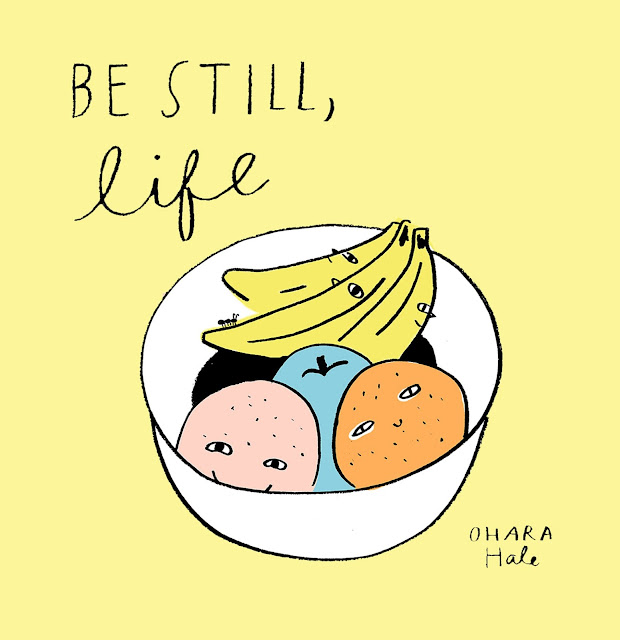
This is a lovely book full of bright, happy colors. Featuring fun rhyming words about nature and animals, "Be Still, Life" wonderfully captures a sunny, warm day, just when all the bugs, people, and creatures come out of hiding. The illustrations are a delightful sort of chaos, just like life, and may help children find inner peace and calm in what may seem like a busy mess of movement and energy. Slow down and point out the things you *can* see, hear, touch, feel, smell... and one by one they will come to you and silence your worry and anxiety, asking you to look within. "Be Still, Life" is a story for children (and adults) about being present in the world, being aware of what surrounds you, and embracing each moment of our special lives. A perfect book for spring and early summer.

"Sea Shells" by Paul Valery (published 1937)

Image
“Ignorance is a treasure of infinite price that most men squander, when they should cherish its least fragments; some ruin it by educating themselves, others, unable so much as to conceive of making use of it, let it waste away. Quite on the contrary, we should search for it assiduously in what we think we know best. Leaf through a dictionary or try to make one, and you will find that every word covers and masks a well so bottomless that the questions you toss into it arouse no more than an echo.” Paul Valery’s essay, “Sea Shells”, which, in its Beacon Press Edition, is put beautifully within a red covered and gold titled illustrated book, is, quite simply, a masterpiece of thought. It makes sense that this book would not be classified under philosophical works, but rather a form of (literary) criticism and theory. In it, Valery thinks about seashells. His goal is to write down his thoughts and observations of and about seashells without using any pure framework. Even so, this...

"Walden" by Henry David Thoreau (published 1854)

Image
“If you have built castles in the air, your work need not be lost; that is where they should be. Now put the foundations under them.” – Henry David Thoreau As it turns out, Henry David Thoreau, considered by many to be a quintessential American writer, is not as quaint as I may have originally believed. My initial impression of Thoreau was just that – an initial impression - which did not keep me from reading one of his most famous works, “Walden”, even when I came across his more personally disagreeable ideals. The best places to go are places where one does not have to purchase any new clothes, he writes, or the idea that one should maximize (if you will) the concept of minimalism itself. I love clothes as a form of expression as do I love objects (particularly related to artistry), so his ideas seemed *quaint* to me. However, as I started to really contemplate Thoreau’s “Walden”, it became clear that Thoreau actually set a great example in that he came at the world, and the peop...