Posts

"Black Heart, Ivory Bones" Edited by Ellen Datlow and Terri Windling (published 2000)

Image
In this hilarious, enchanting, and moving collection of twenty fairy-tales, readers will traverse through backwater America, the Italian countryside, the moors of England, and still more places that may - or may not - really exist. Featuring storytellers such as Susanna Clarke, who was still just working on her popular novel Johnathan Strange & Mr. Norrell , well-known fantasy writers such as Neil Gaiman, and unlikely fairy-tale authors such as Joyce Carol Oates, this book will delight all those interested in the less explainable aspects of humanity with a renewed appreciation for contemporary creative writing, particularly in the realm of the supernatural and, strikingly, traditional genre that we have come to name fairy-tales.  While now a more ubiquitous pattern in storytelling, Black Heart, Ivory Bones  gives a sense of freshness to the idea of old and new worlds combined; one running rampant with magic and the historical past, and the other filled with the an...
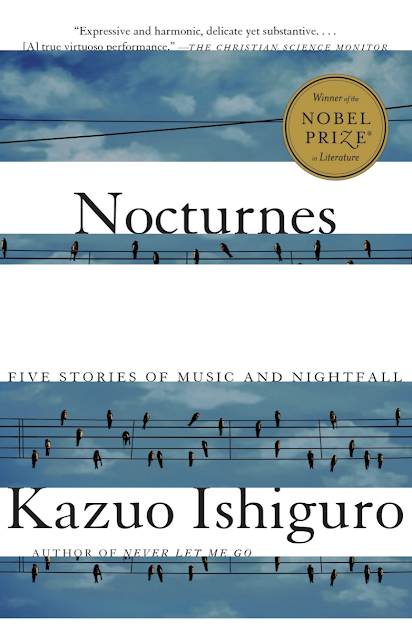
"Nocturnes: Five Stories of Music and Nightfall" by Kazuo Ishiguro (published 2009)

Image
Kazuo Ishiguro's "Nocturnes" features five light and entertaining anecdotal stories concerning music and the rocky lives of traveling classic and classical musicians. The characters in each story vary, yet each is a bit of an odd, awkward bird trying to make it in the music world. The book is very enjoyable and would be the perfect read for a flight. I say this because of the various geographies described, though all European, they are also all not shy in taking liberties of opinion on said cultures and their people: a refreshing take. Nocturnes is reflective of the relationships of ordinary people, and their dreams and goals. Though there was some lack of passion here. The passion of the musicians within the stories was dulled by obstructions of frustration and insecurity. In short, the fire within them, that must live on and grow within any musician's heart and soul, was burning them out. Throughout the book there is a pity underlining the text that wasn't ...

"The Pocket Rumi" by Rumi, edited by Kabir Helminski

Image
Rumi (1207 - 1273), a now much quoted poet, is also an Islamic saint. In The Pocket Rumi , a good amount of his poems and verses are published, and out of these many referenced Christianity: Jesus and even the Virgin Mother. Not in a negative light at all. I do feel it is of importance to note Rumi's Persian and Islamic background. The prophet Muhammad is also mentioned very frequently in his work, which drew me to a closer understanding and appreciation of Islam, without having to open the Koran.  Frankly, it doesn't sit well that a lot of his poetry is not something we might call common humanity or shared human values. Tell me, what historical struggle, what coming together of societal conditions, what political events urges a person such as Rumi towards  love?  Rumi doesn't believe in good and evil, in the moral sense, but he cannot deny his striving towards  goodness . It's in his work, this combining of goodness and love and also, quite differently than t...

"The Awakening" by Kate Chopin (published 1899)

Image
I don't think Kate Chopin's intention with her novel, The Awakening, published in 1899, was to shock or entertain. Both reactions indeed took over the masses when the book was published. But Chopin, I believe, meant to teach, meant to illustrate an example. I also do not think that Chopin's main character, Mrs. Edna Pontillier, was one to entertain or one who wanted to. However, Mrs. Pontillier did entertain by way of beginning to perform and act out her life for herself, and herself alone. Her witnesses and acquaintances looked on with curiosity and concern, and love.  Put simply, The Awakening is a novel exploring societal values regarding women during the turn of the 19th century (1899). The lush backdrop of the Grand Isle in Louisiana only compounds the emotional turmoil the protagonist, Mrs. Edna Pontillier, finds herself coping with one oppressive summer. As a married woman with children, Mrs. Pontillier finds it difficult to express the psychological changes...

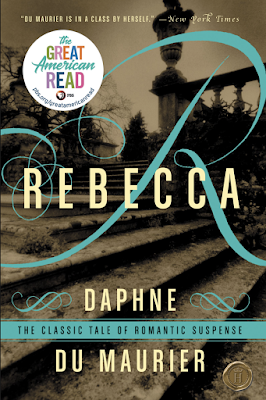
"Rebecca" by Daphne Du Maurier (published 1923)

Image
I don't think I've ever eaten as much while reading a novel as I did while reading Daphne Du Maurier's classic Rebecca, first published in 1923. Classic novel it is. Rightly so. Like the unnamed main character, I bit my by fingernails (my right pinky nail, specifically) down to the quick as I thrust pages onto the next in nervous suspense. Down went my crackers, sandwich, cookies, fried rice, chips, and dip. Down went plenty of tea, and much too much coffee, which is what is allowing me to write at this very moment when it typically is bedtime for me.  To me, Du Maurier has captured in this book not just an excellent story but a superb example of what it may be like to be borne unto the world. A birth into the first part of the 20th century, in Britain, to be sure, but a birth nonetheless. The phrase coming-of-age is much to trite for this novel. The birth is a terrible one, of shock and disbelief. The narrator is a kind of still-born (for lack of a better metapho...

"Embassytown" by China Mieville (published 2011)

Image
Because of the ingenuity behind China Mieville's "Embassytown" (2011), the book is enormously fun to read. Like many science fiction books I've picked up before, there was a point when I was aware that I was not comprehending all of what I was "reading", but continued happily on anyway, willing to do the work, understanding what I could, while letting the story flow page by page freely. Usually the ability for the reader to do that with a complex story structure and highly intellectual content is a sign of great style. And that - amazing literary style - is something Mieville certainly does have. This is the first Mieville book I've picked up and I was absolutely mind-blown by its concept. With language as the main thematic element, I emerged myself in the wonderful linguistic games, using my own sparse knowledge of Saussurian semiotics to back-up what I thought I was "getting". Beyond that, I loved the symbolism of the book, which Mieville...

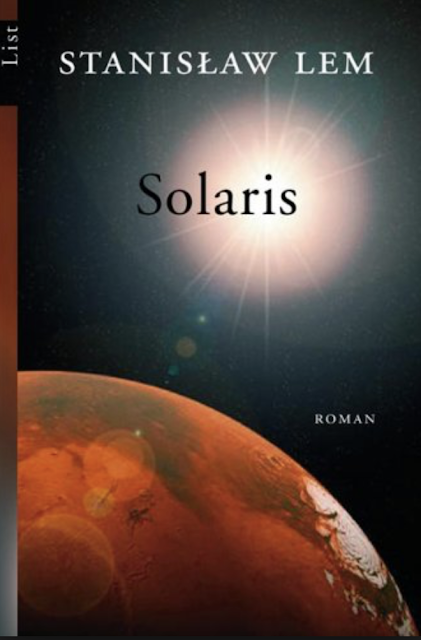
"Solaris" by Stanislaw Lem (published 1961)

Image
For words, we have extensive etymologies, for literature we have comprehensive exegeses, for life we have philosophy, for history we have critical theories, for art we have historical analyses, and the same goes for science. The whole of Stanislaw Lem's  Solaris  (from French and published in 1961) is a beautiful study in  bodies of work such as those, and how, as time passes and consciousness changes, all these criticisms, theories, and conclusions merge and die, sometimes becoming irrelevant or outright wrong, or else become case studies in hysteria or some other psychological manifestation, all the while developing a chronological set of *facts*. The subject in Lem's elegantly written novel is the planet Solaris, a planet that has been under the observation and scrutiny of scientists for thousands of years. The protagonist of this story is Kris Kelvin, a psychiatrist who became fascinated with the planet as a child and consequently dedicated his entire life to it,...